
Self-Led Love: How Healing Your Relationship with Yourself Improves Your Marriage
June 8, 2026
Most relationship advice focuses on how to talk to your partner-the right scripts, the "I" statements, and the active listening techniques. But what if the secret to a better marriage isn't how you talk to your spouse, but how you talk to yourself?
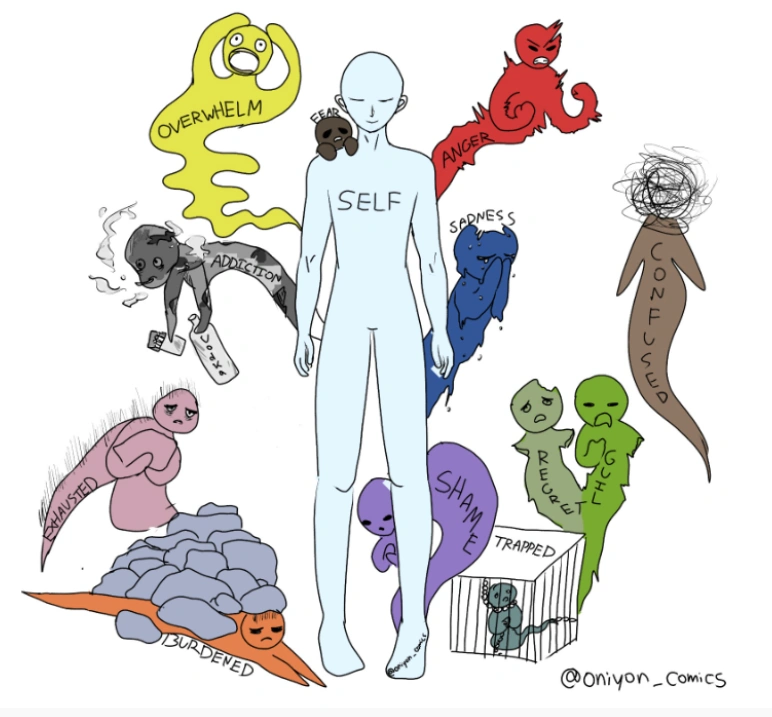
Your relationship with your inner world is the foundation for every external connection you have. According to the Internal Family Systems (IFS) model founded by Dr. Richard Schwartz, our minds are not a single unit. Instead, we are a system of "Parts," some wounded (Exiles) and some protective (Managers and Firefighters), all revolving around a core Self. This Self is characterized by the "8 Cs": calmness, compassion, clarity, curiosity, confidence, courage, creativity, and connectedness.
Conflict Isn't Always About Your Spouse
When we are in the heat of an argument, we aren't usually leading with our "Self." We are being run by our Parts. In a partnership, we subconsciously expect our spouse to soothe our wounded parts or "deal" with our protective parts when they take over.
Think back to a recent conflict. Did you feel an urgent need to withdraw, raise your voice, make a snarky comment, or staunchly defend yourself? These are your Protectors. They are trying to shield a more vulnerable part of you from pain, but in doing so, they often trigger your partner's Protectors, creating a "Protector-to-Protector" standoff where no one feels heard.
The Power of the "U-Turn"
To break these repetitive cycles, we can practice the "U-Turn." This involves shifting the focus from "What is my spouse doing to trigger me?" to "Which part of me is activated right now?" Practicing the U-Turn looks like this:
- Pause: When you feel an interaction heating up, take a beat.
- Focus Inside: Notice the part holding the reaction. Is it a critic? A runner? A fighter?
- Differentiate: Name the part. Instead of saying "I am angry," try saying, "I notice a part of me feels very angry right now." This simple shift in language creates "space" between you and the emotion. By differentiating, you prevent the part from completely "blending" with you, which allows your Self energy to step back into the driver's seat.
Plus, if you're able to offer compassion and care to your activated parts in the moment, this allows for even more space for Self to run the show. When you meet your defensive or angry parts with curiosity instead of judgment, they soften, allowing your core, calm Self to take the lead.
Communicating from Self-Leadership
When you lead from Self, the dynamic of the conversation changes. Instead of attacking, you can say to your partner: "I'm noticing a part of me is feeling very defensive right now and wants to lash out. I need a moment to settle so I can really hear you."
This level of transparency is transformative. It allows your partner to see your internal struggle with compassion rather than feeling the need to defend themselves against your "angry part." This vulnerability often invites their Self to emerge, creating a safer environment for actual resolution.

Relieving the Burden of "Fixing"
One of the most profound shifts in Self-led love is the realization that our partners cannot heal our deepest wounds. Only our own Self can do that. When we stop looking to our spouse to be our primary "regulator," we relieve them of an impossible burden.
This decreases patterns of codependency and fosters a "Self-to-Self" connection. We can witness our partner's pain without becoming defensive because we know their pain isn't a failure on our part. We can offer support without trying to "fix" or rush their process.
Transforming Your Marriage from the Inside Out
Healing your marriage doesn't always start with a difficult conversation with your spouse; often, it starts with a compassionate conversation with yourself. By becoming a curious student of your own internal system, you stop reacting to the present through the lens of the past.
As you cultivate Self-leadership, you'll find that you aren't just improving your marriage; you're accessing a more resilient, compassionate version of yourself. And that is the greatest gift you can bring to any relationship.